

The Other D-Word
Why devotion will take you places discipline can never go

What is it that keeps creators steadfastly committed to our work?
Most of us have been taught that the answer is Discipline.
It is discipline, we’re told, that puts butts in chairs and adheres us to a consistent routine. Discipline transcends the vicissitudes of our moods and emotions and enacts our submission to a purpose greater than ourselves. Through discipline, we learn to channel the power of our will in the direction of our choice.
That’s the story, anyway.
When you think of your desires to create and reckon with the times you’ve failed to put those desires into action, have you ever diagnosed yourself as not having enough discipline?
When you look at prolific artists you admire and compare yourself to them, do you ever think “well, they’re just more disciplined than me”?
Have you ever staged a disciplinary crackdown on yourself: “I will make a video every day at the same time” or “I will paint a minimum of 3 days a week” or “I will get up at 5:00 am to write. No. Matter. What.”?
How’s that working for you?
If you are anything like me or my coaching clients, the answer is “not great.” And I think I know why.
Discipline is not the right D-word for most creators
Why? Because discipline is the preferred strategy of the Ethos of Productivity, and the Ethos of Creativity demands a different approach.
In the ethos of productivity, our highest aspiration is to impose our will upon the world. And when we ask “How can I best impose my will upon the world?” the answer comes back, “You must begin with self-discipline.”
In the ethos of productivity, learning to impose our will upon ourselves by “gaining control” of our thoughts, emotions, and behaviors - and by extension our schedules, plans, and tasks - prepares us to control the world around us. “Self-mastery” becomes the inaugural battle that prepares us for a life lived in a perpetual war to bend the world to our will, demanding that it conform to our vision and our plan.
When we bring this mindset to our creative workspaces, the results are disastrous. When we make ourselves and our art the objects of our control - when we tighten up, crack down, and demand submission - we set ourselves in opposition to the liveliest parts of ourselves and our work. With the tightness of our determination to “get a grip,” we strangle the flow of our aliveness, our joy, and our original voice.
Our efforts at discipline can also give rise to violent inner battles between our willpower and our natural desire for freedom - unwinnable battles that do nothing but distract us from our purpose. Our creative spirits fundamentally don’t want to be - indeed CAN’T be - mastered or forced into submission, and trying to do so is what Stephen Nachmanovich calls “the most dangerous trap.”
In his masterwork Free Play: Improvisation in Life and Art, Stephen Nachmonovitch says:
“One of the great traps at times of blockage is that we may accuse ourselves of a deficit of concentration and focus, a deficit of discipline. We then take a paternal or militaristic attitude toward ourselves. We will force ourselves to work, we will go on a schedule, we will take vows. The most dangerous trap is to get into a contest of strength between “will power” and “won’t power.”
The Creativity Ethos Alternative
OK, so if the quest for discipline leads us into un-fruitful, self-demeaning inner battles, and connects us with an unhelpful paradigm of control and mastery…what is it that creators SHOULD aspire to? What is it that keeps creators working steadfastly on their creations?
It seems to me that the answer is another D-word entirely, the word Devotion.
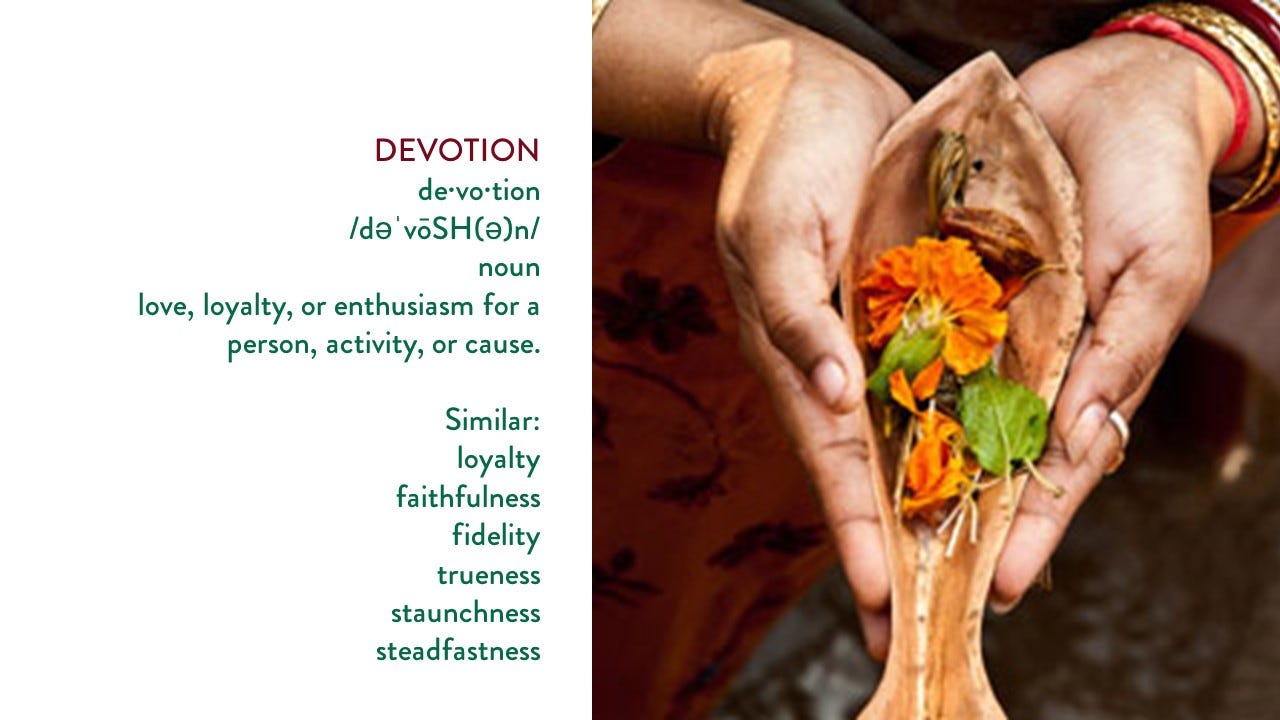
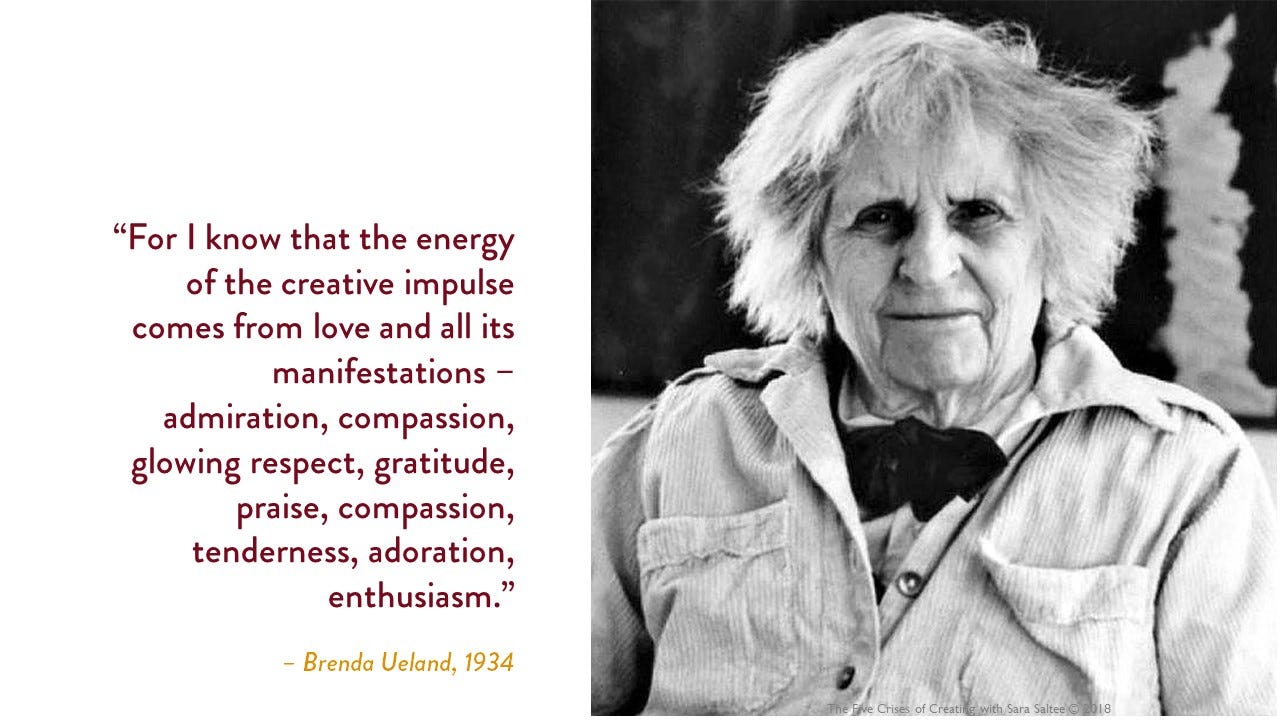
Why devotion? Simply put, devotion is the faithful expression of love, and creativity arises from love. As Brenda Ueland puts it, “…the energy of the creative impulse comes from love and all its manifestations.”
In other words, aligning ourselves with the energy of creating means aligning ourselves with the energy of loving.
Powerful hearts, not powerful wills
Listen to Annie Dillard’s description of what really propelled the work of some of the “Great Men” whose work we revere:
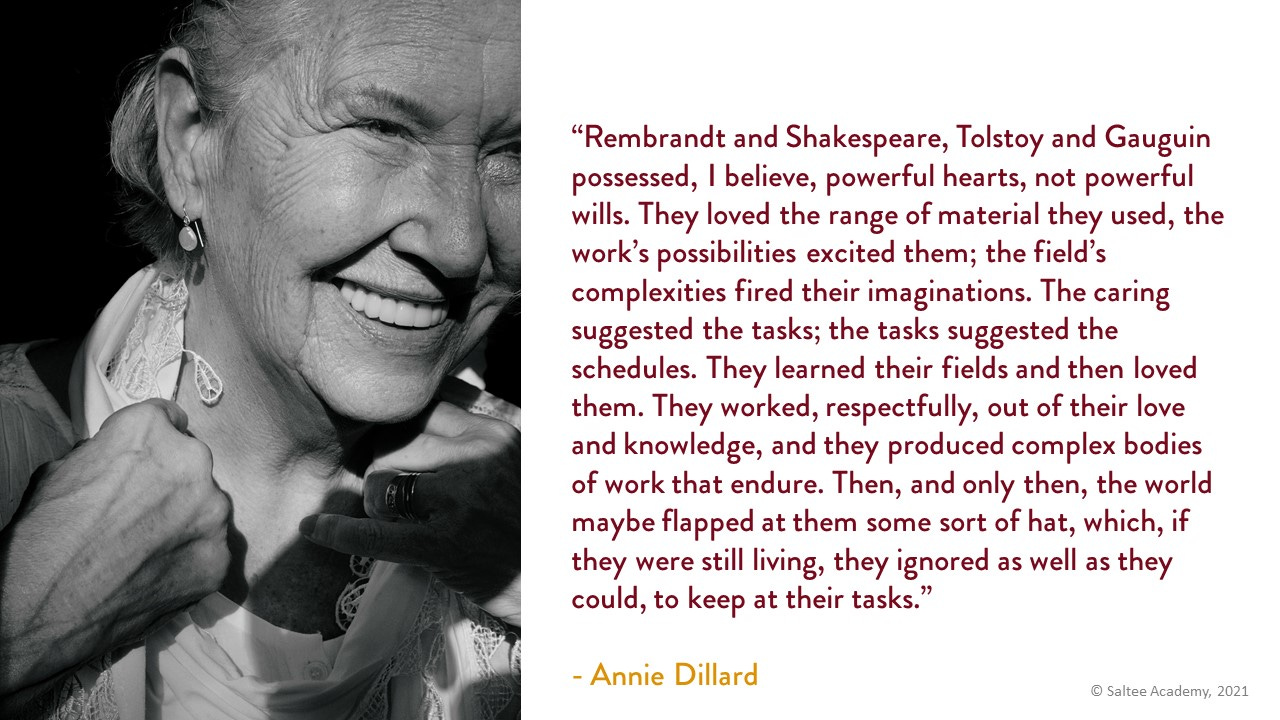
Dillard’s insistence that meaningful creative work results from the expression of a steadfastly caring heart rather than from the exertion of a powerful will starkly contradicts how we’ve been acculturated to think about the nature of accomplishment, doesn’t it?
in Dillard’s estimation, the hard work, the tasks and schedules, and the stubborn tenacity that we have been trained to read as evidence of great discipline are actually evidence of great love.
Enduring creative works, she suggests, emerge from a loving and respectful relationship with our field of play, and it is our engagement in this relationship - born from deep impulses of curiosity and care - that supersedes even our desires for external praise or recognition. No honors or awards are more meaningful than our sustained connection to our true beloved: the work unfolding.
The Nature of Creative Love
What kind of love is this? Robert Fritz puts a name to the particular kind of love that Dillard ascribes to the great artists on her list, calling it “generative love.” In generative love, we don’t love in response to something that already is, we love a possibility that does not yet exist or a question that incites our passion, and by loving, we bring the new possibility into being.
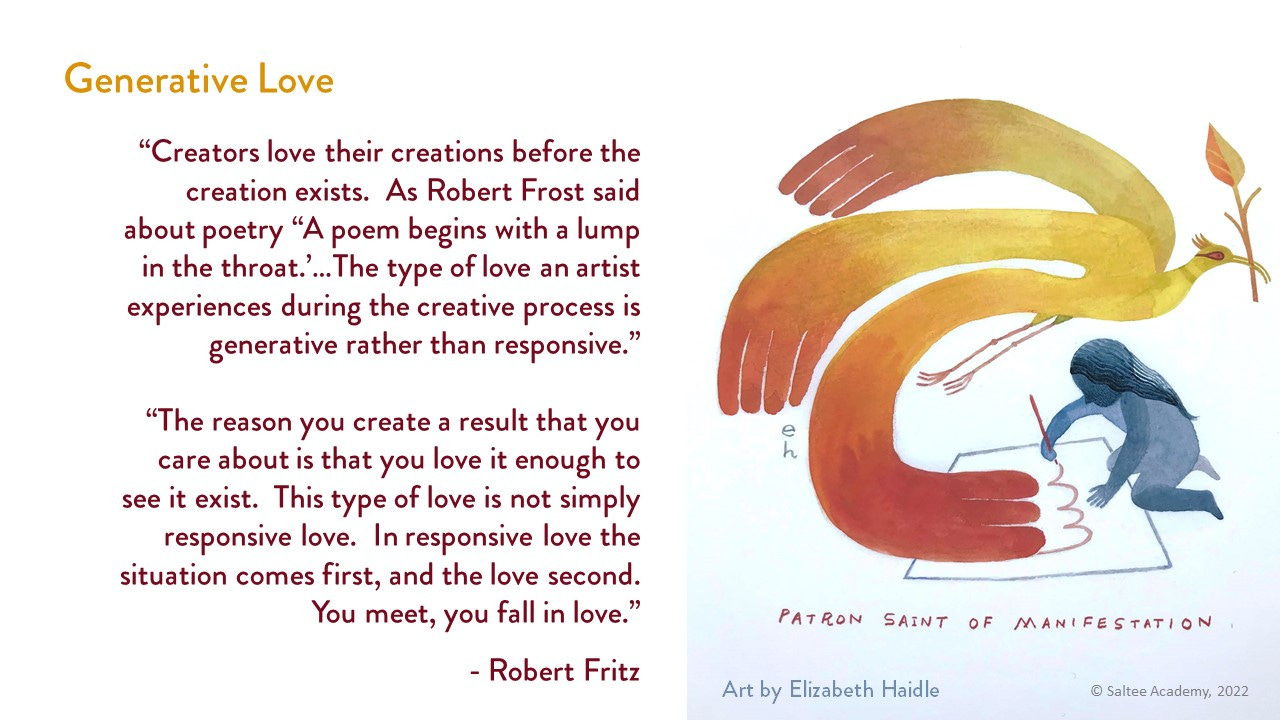
The path of generative love requires us to move past the shallows of self-love (“Gee, I’d look great on a book cover” or “Wouldn’t I look lovely painting in a beautiful sun-dappled studio?”) and into a deeper relationship. Generative love urges us toward devotion to the creative practice(s) through which we enact our love and to the projects that we are loving into being.
Here’s the tricky part
The tricky bit about generative love is that loving something that doesn’t yet exist requires us to give our devotion to something that we can’t fully know or understand, something that makes no guarantees. This is not easy!
Entering into a relationship with an emerging thing requires us to suspend our need to know and predict in favor of listening closely to what the work wants and needs from us. In other words, we have to learn how each particular project wants to be loved.
Is the practice or project to which you are devoting yourself asking for a long marriage or just a sweet dalliance or an affectionate friendship? Does it need to be courted coaxed, and wooed forward or is it already ripe and ready to fall onto the page, the canvas, or the crock pot?
David Whyte says it this way:
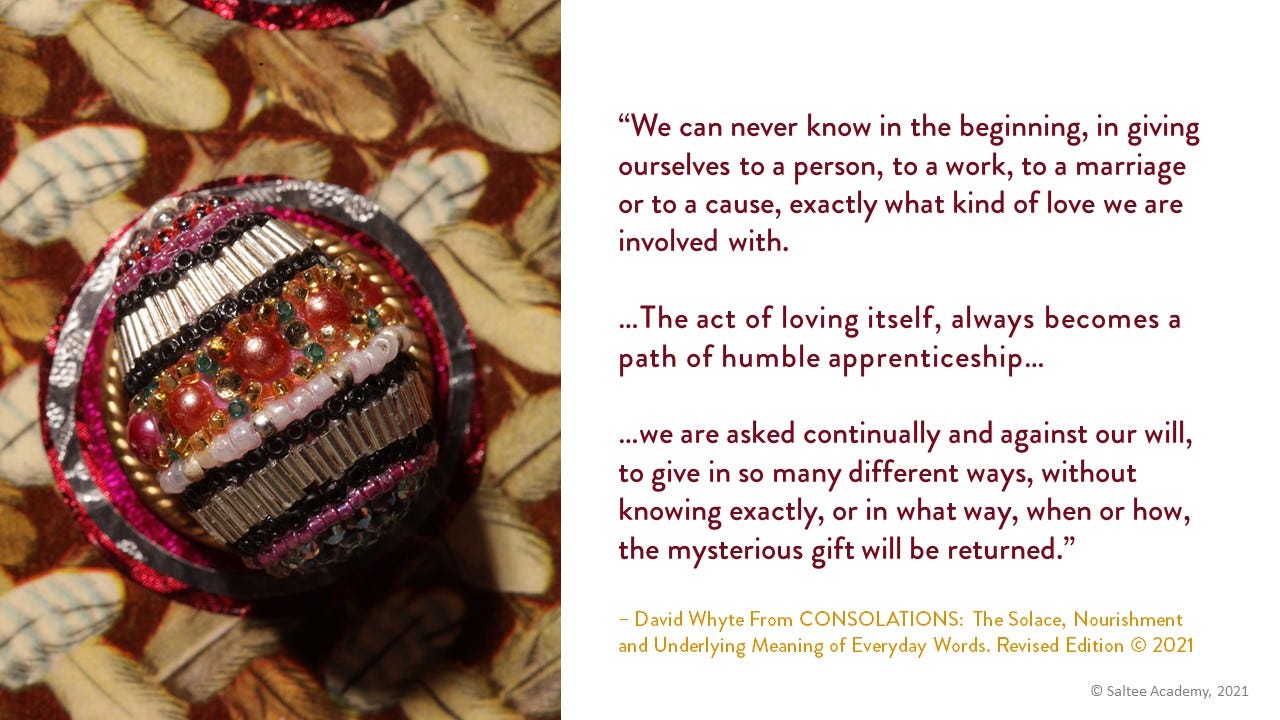
Notice how Whyte speaks of “will” here? “We are asked continually and against our will to give in so many different ways…”
Like Dillard, Whyte is offering us an alternative to the story of discipline and will. The practice of humbly extending our hearts to the as-yet-unknown is the opposite of exerting control over anything. Instead, the practice of generative love Whyte describes requires us to release control - even going against our will - in order to give ourselves over to the deep discomforts of the unknown. Entering into a loving relationship with an emerging idea or possibility means allowing ourselves to be guided and changed by our unfolding experience of interplay with our beloved.
This openness to being changed by our encounters with our work is central to the ethos of creating.
A model of devotion
The cellist Pablo Casals is one of my favorite models for what a life of creative devotion can look like. When he was in his nineties, Casals sat for a series of interviews in which he spoke at length about the set of daily practices that opened in him an experience of loving connection to the world.
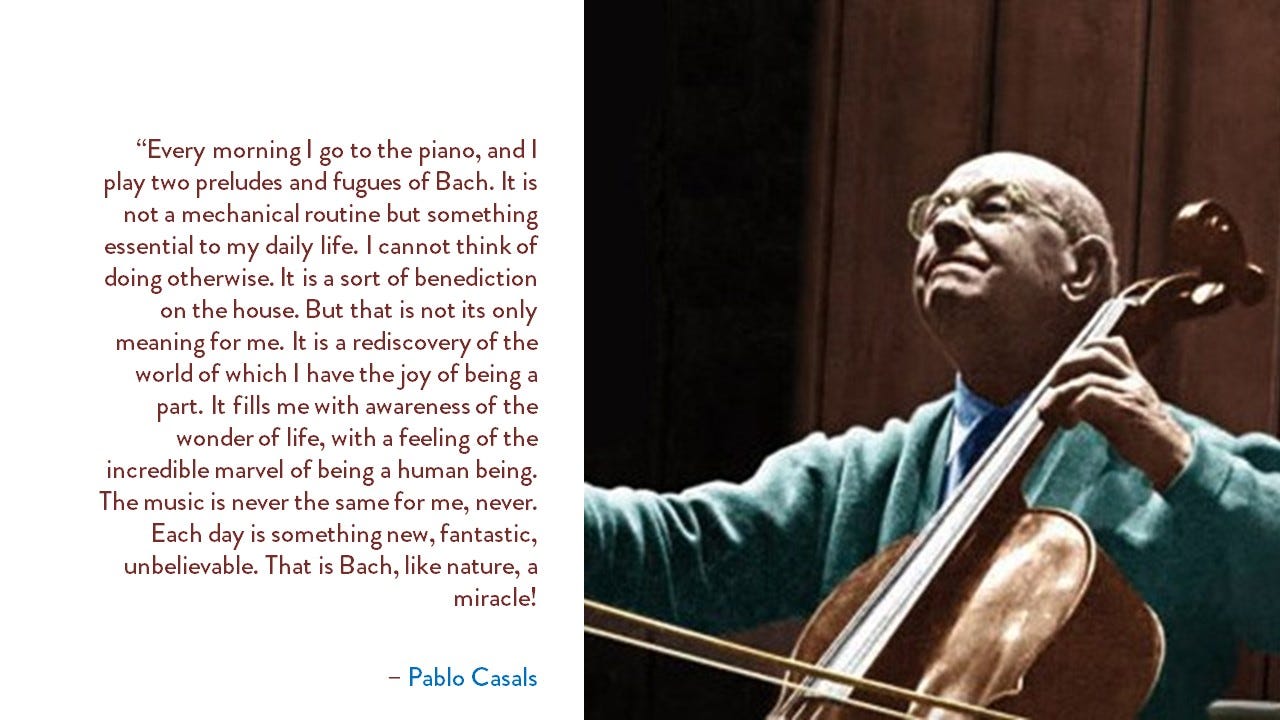
In his lifelong commitment to remaining open to life, Casals reminds us that the ultimate gift of generative love is the joy of discovery and rediscovery of both self and world. It is so clear that the “essential” habit of beginning each day with Bach, was not, for Casals, a routine that emerged in the spirit of discipline. There is nothing in what he describes that evokes a sense of self-mastery or imposition of will.
What he describes instead is a practice of devotion, a “benediction” through which he sustains an open, loving, alive relationship to a dynamic, living world. What thrills me is how he remains open to being changed, willing to let the field of his creative play shape his understanding and shift his perspective.
In his engagement with Bach, Casals is simultaneously grounding himself in something deep and unchanging and connecting himself to the realization of endless change, endless newness, endless possibility.
A Sacrament of Love
In our time of normalized hyper-productivity and corrosive flirtation with Artificial Intelligence as “artist,” it feels urgent to me to call us, the artists of the world, to reconnect with the spirit of loving devotion that is at the root of our creating.
More than this, it feels urgent that we speak proudly and without defensiveness about our devotion and about the caring and curiosity that animates our hard work.
If we don’t advocate for the values and aspirations of the ethos of creativity, who will?
If we can’t articulate the supreme value of interconnection, interchange, and interplay, who will?
If we don’t remind ourselves and each other that creativity is not a way of making snazzy products, it is a way of evolving ourselves and the world by engaging in loving and curious relationships with the dynamic, emergent forces of nature and culture, who will?
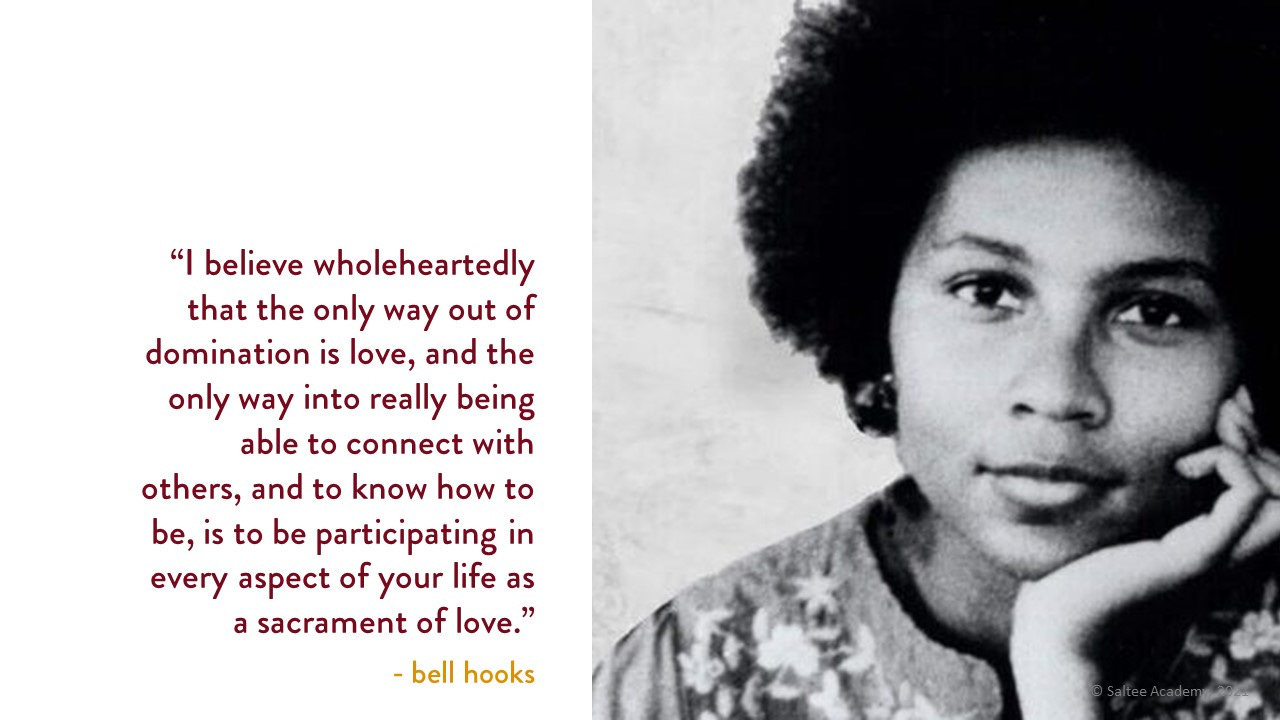
Of all the powerful and provocative advocates for the Ethos of Creativity, bell hooks was surely one of the most articulate, so I will gratefully give her the last word for today:
Five questions to ponder:
What would it feel like to relieve yourself of the thought that you should be better disciplining yourself?
What would it look like to focus on deepening or expanding your experience of devotion instead?
To what are you devoted?
How does the field or object of your devotion wish to be loved?
Are you allowing your schedules and tasks to flow from the deep logic of what you love, or have the tails of schedule and task been wagging the dog of loving devotion?
Have some thoughts you’d like to share? Please leave a comment!
Upcoming Events:
Join me online for a Saltee Bite workshop - a live, interactive monthly taste of Saltee Goodness!
The October Bite on the topic “Expanding Our Capacity for Creative Play” is happening on Thursday, October 12 from 10 - 10:50 Pacific Time.
The November Bite will be “Three Practices to Boost Your Creative Confidence.” Thursday, November 9, 10 - 10:50 Pacific Time.
(And this is so very timely! Just last week I decided to allow devotion to be the bedrock of how I move through my days and nights in this increasingly heartbreaking time.)
Wow, Sara, for me this is the deepest, most soul-filled, and most powerful essay I've ever read by you (or just about anyone else). Your writing is so imbued with the very thing you honor, deep devotion. A deep bow of gratitude for your offering.